In production
Scrap Jobs
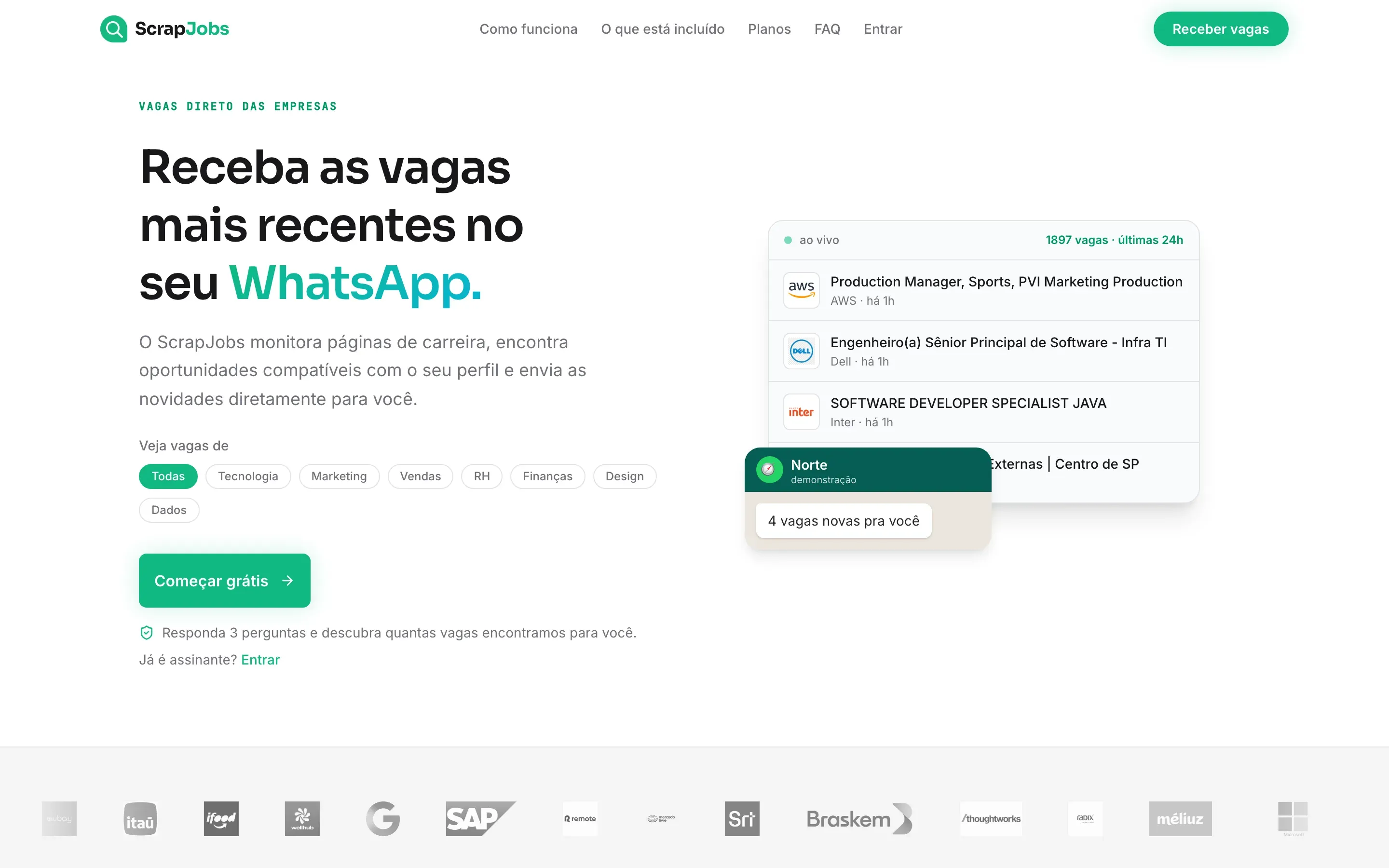
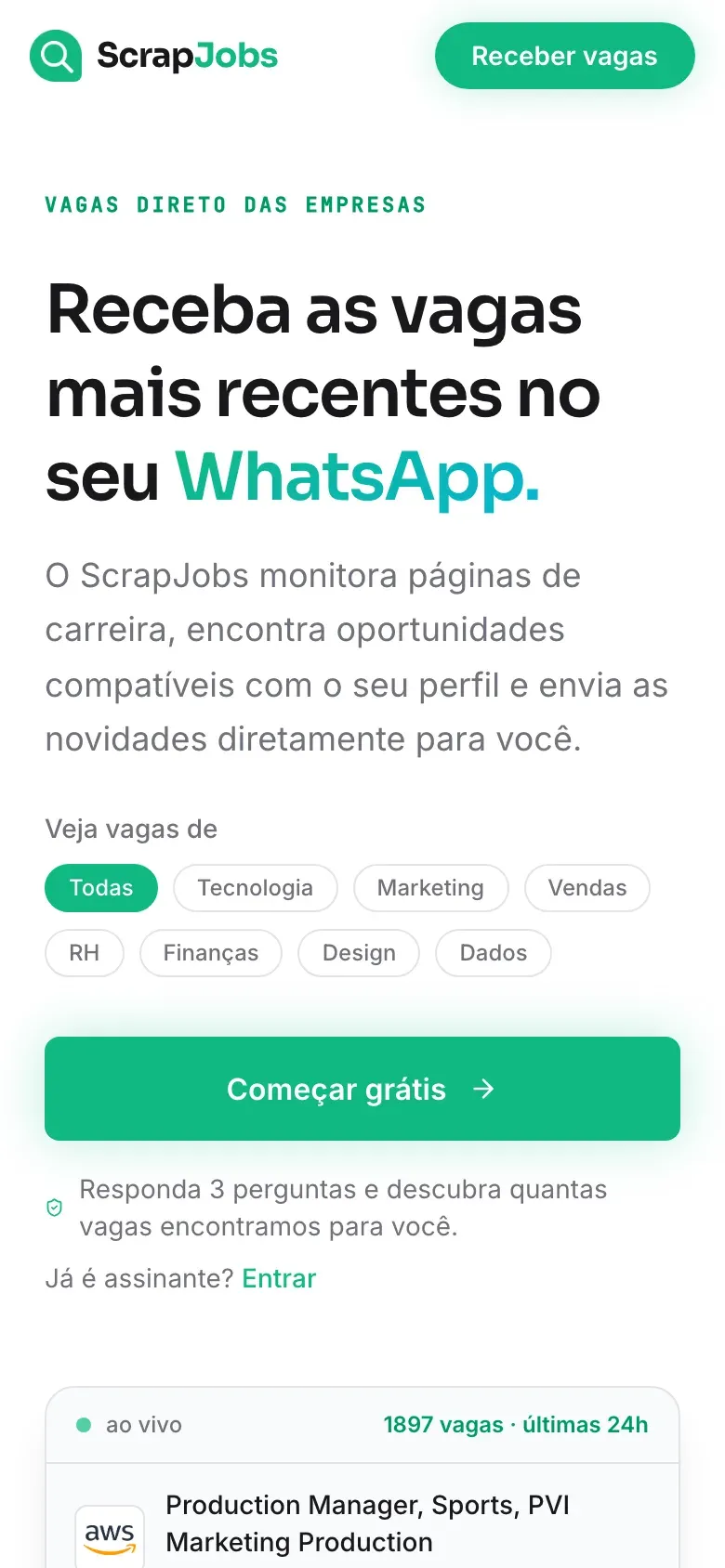
A job radar built as five coordinated services, with an LLM classifying openings and an AI agent answering candidates on WhatsApp.
The problem
Relevant openings are scattered across dozens of career pages, and checking them by hand does not scale.
What I built
Five services — a Go API, a Go worker, a Go scheduler, a Python agent that talks to candidates on WhatsApp, and a React frontend — coordinated through Redis queues.
Technical decisions
I split the system into five independently deployed services — an API, a worker, a scheduler, a Python agent for WhatsApp, and a React frontend — mainly to isolate failure domains, not to scale each one independently. The clearest case is headless scraping: it drives a real Chromium instance inside the worker, so it runs on its own queue at a concurrency of exactly one — a stuck tab can slow down headless scraping, but it can never starve matching, email or WhatsApp, because those run through separate queues and separate concurrency pools.
Every unit of work — scraping a site, matching a user against new jobs, sending a digest, answering a WhatsApp message — goes through Redis-backed queues (asynq), not a direct function call. That buys three things I actually use: the scheduler enqueues work and returns immediately instead of blocking on scraping or email; failed tasks retry automatically with backoff instead of silently disappearing; and uniqueness locks stop the same match or campaign task from being enqueued twice while one is already running.
A job posting is uniquely identified by the site it came from plus the source site’s own posting ID, enforced with a partial unique index on (site_id, requisition_id). Re-scraping a site that still lists the same posting doesn’t insert a new row — it hits ON CONFLICT and just bumps last_seen_at. A nightly cleanup job then deletes anything not seen in the last scrape window, so the table only ever holds postings that are still actually live.
The expensive step — an LLM call — never runs on the bulk path. Matching every active user against every new job, which happens twice a day, is pure keyword and location matching with no model involved. The LLM only runs when a user explicitly asks to analyze a job against their resume, and that result is cached per user and job so asking twice doesn’t cost twice. Every request is also structured as JSON output with a detailed system prompt instead of relying on temperature for consistency, and an idempotency ledger means a retried request returns the already-paid-for result instead of billing the same analysis again.
The WhatsApp agent itself holds no state — it’s a stateless Python service that receives the conversation history with every request and returns text. The actual state lives in Go: the last 20 turns and onboarding progress sit in Redis with a 7-day TTL for the hot path, while every message, every agent run and every tool call it made are written to Postgres for a durable, auditable history — including token counts and cost per run, so a runaway conversation shows up in the data, not just in a bill at the end of the month.
Outcome
Running in production, delivering AI-classified openings by email and WhatsApp, with paid tiers unlocked through online payment.
Stack
- Go
- Python
- React
- TypeScript
- PostgreSQL
- Redis
- Docker
- AWS S3